Monthly Letter, December 2022

A New King

Dear Friends,

The Scottish Bible Society have produced for use in schools “a brand new nativity play for 2022”. Called simply ‘A new king’ it picks up on one of the major events of this past year: the fact that there’s not exactly a new-kid-on-the-block but certainly now a new king on the throne.

You can see straight off where the play will be going, so I don’t need to give you a ‘spoiler alert’! But the play (we hope!) will be the centre-piece of our all-age service of worship on the Sunday before Christmas.

A new king, yes, in these lands. And a pointer, too, perhaps: a subtle, silent, sombre tell-tale echo of a deeper, darker, far more all-pervasive change which, almost imperceptibly, has taken place beneath the raucous razzmatazz of round-the-clock-reporting on our countless different screens. For the ‘noise’ of the news which we’re fed every day – of Boris and Brexit; of Covid and conflict; of Truss economics and global pandemics; of Russia, Ukraine and the nations of NATO; of migrants, asylum and scarred refugees; of economic down-turns and a cost-of-living crisis; of climate and Qatar; of bullying bosses and billionaire crooks – the ceaseless cacophonous ‘noise’ from the news which we’re fed every day distracts our attention from the secret insurrection which has taken place.

A whole new kingdom has come. It didn’t come by vote or referendum. It wasn’t ever advertised or publicized. As Gil Scott-Heron put it back some 50 years or so ago, ‘The revolution will not be televised.’ It wasn’t. Not this revolution anyway: not this change of kingdom which has come about across our lands and seen us slowly waking up, almost Rip-van-Winkle-like, to a world we neither recognize nor like.

A whole new kingdom has come. ‘Correctness’ was the camouflage its avant-garde proponents sought to use in bringing in a whole new kingdom culture as the context for our way of life – the dominion of ‘demand’: a strident, scurrilous society, insisting on its rights and on its liberties, with scant regard for where such rights might actually originate and no concern for how such rights translate into profound responsibility.

It’s a kingdom which is rooted in the cavalier philosophy of ‘on-demand’: a world in which the viewers get to watch just what they want, just when they want, and indeed as often as they want as well. Everything must pander to the wishes and the schedules of its citizens: and the language of this kingdom is the harsh, abrasive rhetoric of ‘demand’.

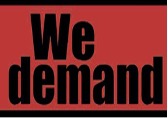
“We demand .,”, and you fill in the blanks of whatever your cause. Hanging from the gantries of a motorway, super-glued to pavements near to Parliament, you choose your spot, disrupt normal life and make your self-righteous demand: the radical Dick Turpins of the modern world, confronting passing traffic on the highways of the nation’s life (the digital highways as much as the fast, commuter motorways), the strap-line of the classic, ruthless highwaymen – ‘your money or your life’ – translated into up-to-date one-liners for our warrior age. No longer ideas, or requests, or proposals. But simply demands. A ‘spoilt-brat’ syndrome given corporate identity.

A whole new kingdom has come. It’s a kingdom in which now everyone is a victim: people deprived and defrauded: people deceived and deluded: people maligned and mistreated. And thus people, as well, who’re entitled, they think, to demand. Someone else is always to blame: and whoever it is must be cancelled and punished and sued. The vicious cancel culture of the kingdom of demand.

And slowly, subtly, underneath the radar of our consciousness, and hidden by the smokescreens of the cataclysmic dramas being reported in the ‘news’, this culture has been firmly institutionalized. For the government, too, speaks this self-same, forceful language of demand; indoctrinating children with the mind of post-modernity; incarcerating those who dare to question this new brand of loose ‘morality’. Demanding that its citizens all toe the line; demanding that they all now sing in monotonic unison; demanding that they sign up to the mantras of their self-defined morality; demanding that an ‘on-demand’ society is how the kingdom’s run – where you get to choose what you watch, who you are, how you live, when you die; because, of course, it’s your right to make such demands.

Of course. The dominion of demand. A whole new kingdom has come.

Except it’s not exactly ‘new’. It’s the ancient Eden kingdom of defiance and desire, dressed up now in the clothes of ‘human rights’, which always makes it seem so very .. well, so very ‘right’. Adam and Eve were conned into this way of thinking, embracing the lie in the line which was cleverly fed to their pristine pride, and asserting, demanding and claiming their right to be gods of the garden they’d got. Their garden. Their lives. Their choice.

Little did they realise that the kingdom they’d been given had been subtly, swiftly twisted and distorted, and had morphed into a ‘made-in-hell’ dominion of both darkness and demand. Their self-understanding changed. No longer mere creatures, they should be now controllers. No longer recipients of a generous grace, they should see themselves now as the victims of cruel oppression, deprived and diminished by ‘colonial’ rule from on high.

‘Demand your rights! Do your own thing! Take what you want! Demand satisfaction!’

The dominion of demand. The callous cancel culture of the kingdoms of this world. Defiant, demanding, deluded.

And into this kingdom came Christmas. A new king. The true King. With a mandate to confront that dark dominion of demand and reinstate the kingdom of the King.

A midnight oratorio from a choir of servant angels: but otherwise, there was no great pomp and ceremony at His coming. No loud and noisy demands, shouting out assertively, incessantly, insisting on His own divine agenda. His kingdom is the converse of the devil-driven dominion of demand.

No wonder He wasn’t received so well. No wonder there were ‘fireworks’. No wonder there were earthquakes and their after-shocks when He, the King, was born. For this was a clash of the kingdoms, a coming together of two tectonic, spiritual ‘plates’, and the whole earth felt the shudder.

A baby in a manger, on the one hand, as the ‘signature tune’ of the kingdom of God – away in a manger .. no crying He makes. And the baddie in the manager that Herod (as the archetypal subject of the kingdom of demand) had become, on the other hand – demanding he be told about the baby who’d been born, demanding that the wise men should report back to himself without delay, demanding that the infant boys in Bethlehem be slaughtered one and all.

No crying he makes? Er, no. Anything but. It’s the loud and noisy, screeched demands of the self-same, ‘spoilt-brat’ syndrome. Crying? Oh yes! The cries of his own self-seeking demands: and the consequent cries of the little town of Bethlehem – ‘Rachel weeping for her children’.

A whole new kingdom had come in the birth of our Lord Jesus Christ. A new kingdom. The true kingdom. And the oldest kingdom of all. The kingdom of God. And its values so totally different.

Maybe today we’re now much better placed to discern just how different the kingdom of God really is: how stark is the contrast between the two realms, how crucial the step that we’re all of us summoned to take in entering the kingdom of God. For there’s no middle ground.

Maybe today we’re much better placed to exult in the birth of our Lord Jesus Christ, to delight in the kingdom which He has established and rules, and to live out our lives reflecting now the fundamental values of that kingdom of our God.

The language of demand is not what Jesus speaks. Submission, not assertion is the first great, constant value of the kingdom of the Lord. Though He was in very nature God, He did not count equality with God something to be grasped or seized, far less demanded as His right. Instead, He became as nothing, divested Himself of all that was His and took the form of a servant – a servant who would walk the path of quiet, glad obedience, and whose undemanding servanthood would culminate in sacrifice. Welcome to a whole new world!

The new King who’s the true King and the oldest King of all – the King Himself has come: and with the King, the Kingdom; and a whole new set of values, a whole new way of doing things, which in truth is just the ancient and eternal way of life. He turns the old dominion and its mantra of demand – He turns that old dominion on its head.

Submission, service, sacrifice, together they’re the keynotes of His coming, the three, great primary colours of that kingdom which has come and still is yet to come.

And all the bit-part players in the drama of His coming, all of those who grasped those bare essentials of the Kingdom as it’s meant to be, they speak and live the language and the lifestyle of that realm. Do you see that in those much-loved Christmas narratives?

Joseph and Mary, they’re out on the road, the God-directed highway of a ready, calm obedience, and an undemanding, ‘do-Your-will’ submissiveness: wherever it leads, whatever it costs. “I am the Lord’s servant. May Your word to me be fulfilled.”

The Bethlehem shepherds, they too are out on the road, on the move. Not blocking the road with their stubborn demands but blazing a trail for others as they live the servant lifestyle and obey the word of God: not demanding compensation for their interrupted night, but displaying real commitment and submission to the King.

And those wise men from their far-off eastern lands, they also, so it seems, had caught some sense not only of the coming of the King for whom all history had been waiting, but also of the values of the kingdom which He ruled.

How submissive they were! How obedient they were to the logic of a gospel truth they’d learned – the promise from a bygone age, as ancient as it was in truth obscure, the promise of a future, favoured King; and the summons, with the promise, to present themselves submissive at His throne.

How eager they were to serve! How ready they were to put in ‘the hard yards’ (all those hundreds of miles) – and make themselves available to serve. “I am the Lord’s servant. May Your word to me be fulfilled.”

And how bold they were in putting their lives on the line! Sacrifice. Giving their best and giving their all in gifts which spoke themselves of sacrifice; setting no limits on what they would do, or where they would go, or how much they might have to lose.

Not a trace in these men of that ‘Eden-esque’ philosophy of ‘on-demand’. A whole new kingdom had come; and they gladly, therefore, sought to give a welcome to the King, and welcome, too, the ethos and the values of the kingdom which He brought.

So, ‘a new king’ here this Christmas. Three short words, pregnant with whole layers of solemn truth. A new man as the monarch. And a whole new kingdom as well has slipped in through the back door of our national life. A stark and sinister contrast to the kingdom which the new, true King established when He laid aside His majesty, entered our world as a helpless, human babe, and gave His life at Calvary that we might live.

Christmas was the clash of contrasting kingdoms, between which there is never any middle ground. And running through these Christmas celebrations there’s always only one great set of questions to address. Whose side are you on? Which kingdom do you live in? What values do you cherish and what language do you speak?

The coming of the new, true King both sifts and sorts us all: “everyone went to their own town to register.” Where do you belong?

May we mark this Christmas season with a bold, fresh registration in the city of the King!

Yours with warm Christmas greetings and with great gratitude in Christ for you all,

Jeremy Middleton

A New King

Dear Friends,

The Scottish Bible Society have produced for use in schools “a brand new nativity play for 2022”. Called simply ‘A new king’ it picks up on one of the major events of this past year: the fact that there’s not exactly a new-kid-on-the-block but certainly now a new king on the throne.

You can see straight off where the play will be going, so I don’t need to give you a ‘spoiler alert’! But the play (we hope!) will be the centre-piece of our all-age service of worship on the Sunday before Christmas.

A new king, yes, in these lands. And a pointer, too, perhaps: a subtle, silent, sombre tell-tale echo of a deeper, darker, far more all-pervasive change which, almost imperceptibly, has taken place beneath the raucous razzmatazz of round-the-clock-reporting on our countless different screens. For the ‘noise’ of the news which we’re fed every day – of Boris and Brexit; of Covid and conflict; of Truss economics and global pandemics; of Russia, Ukraine and the nations of NATO; of migrants, asylum and scarred refugees; of economic down-turns and a cost-of-living crisis; of climate and Qatar; of bullying bosses and billionaire crooks – the ceaseless cacophonous ‘noise’ from the news which we’re fed every day distracts our attention from the secret insurrection which has taken place.

A whole new kingdom has come. It didn’t come by vote or referendum. It wasn’t ever advertised or publicized. As Gil Scott-Heron put it back some 50 years or so ago, ‘The revolution will not be televised.’ It wasn’t. Not this revolution anyway: not this change of kingdom which has come about across our lands and seen us slowly waking up, almost Rip-van-Winkle-like, to a world we neither recognize nor like.

A whole new kingdom has come. ‘Correctness’ was the camouflage its avant-garde proponents sought to use in bringing in a whole new kingdom culture as the context for our way of life – the dominion of ‘demand’: a strident, scurrilous society, insisting on its rights and on its liberties, with scant regard for where such rights might actually originate and no concern for how such rights translate into profound responsibility.

It’s a kingdom which is rooted in the cavalier philosophy of ‘on-demand’: a world in which the viewers get to watch just what they want, just when they want, and indeed as often as they want as well. Everything must pander to the wishes and the schedules of its citizens: and the language of this kingdom is the harsh, abrasive rhetoric of ‘demand’.

“We demand .,”, and you fill in the blanks of whatever your cause. Hanging from the gantries of a motorway, super-glued to pavements near to Parliament, you choose your spot, disrupt normal life and make your self-righteous demand: the radical Dick Turpins of the modern world, confronting passing traffic on the highways of the nation’s life (the digital highways as much as the fast, commuter motorways), the strap-line of the classic, ruthless highwaymen – ‘your money or your life’ – translated into up-to-date one-liners for our warrior age. No longer ideas, or requests, or proposals. But simply demands. A ‘spoilt-brat’ syndrome given corporate identity.

A whole new kingdom has come. It’s a kingdom in which now everyone is a victim: people deprived and defrauded: people deceived and deluded: people maligned and mistreated. And thus people, as well, who’re entitled, they think, to demand. Someone else is always to blame: and whoever it is must be cancelled and punished and sued. The vicious cancel culture of the kingdom of demand.

And slowly, subtly, underneath the radar of our consciousness, and hidden by the smokescreens of the cataclysmic dramas being reported in the ‘news’, this culture has been firmly institutionalized. For the government, too, speaks this self-same, forceful language of demand; indoctrinating children with the mind of post-modernity; incarcerating those who dare to question this new brand of loose ‘morality’. Demanding that its citizens all toe the line; demanding that they all now sing in monotonic unison; demanding that they sign up to the mantras of their self-defined morality; demanding that an ‘on-demand’ society is how the kingdom’s run – where you get to choose what you watch, who you are, how you live, when you die; because, of course, it’s your right to make such demands.

Of course. The dominion of demand. A whole new kingdom has come.

Except it’s not exactly ‘new’. It’s the ancient Eden kingdom of defiance and desire, dressed up now in the clothes of ‘human rights’, which always makes it seem so very .. well, so very ‘right’. Adam and Eve were conned into this way of thinking, embracing the lie in the line which was cleverly fed to their pristine pride, and asserting, demanding and claiming their right to be gods of the garden they’d got. Their garden. Their lives. Their choice.

Little did they realise that the kingdom they’d been given had been subtly, swiftly twisted and distorted, and had morphed into a ‘made-in-hell’ dominion of both darkness and demand. Their self-understanding changed. No longer mere creatures, they should be now controllers. No longer recipients of a generous grace, they should see themselves now as the victims of cruel oppression, deprived and diminished by ‘colonial’ rule from on high.

‘Demand your rights! Do your own thing! Take what you want! Demand satisfaction!’

The dominion of demand. The callous cancel culture of the kingdoms of this world. Defiant, demanding, deluded.

And into this kingdom came Christmas. A new king. The true King. With a mandate to confront that dark dominion of demand and reinstate the kingdom of the King.

A midnight oratorio from a choir of servant angels: but otherwise, there was no great pomp and ceremony at His coming. No loud and noisy demands, shouting out assertively, incessantly, insisting on His own divine agenda. His kingdom is the converse of the devil-driven dominion of demand.

No wonder He wasn’t received so well. No wonder there were ‘fireworks’. No wonder there were earthquakes and their after-shocks when He, the King, was born. For this was a clash of the kingdoms, a coming together of two tectonic, spiritual ‘plates’, and the whole earth felt the shudder.

A baby in a manger, on the one hand, as the ‘signature tune’ of the kingdom of God – away in a manger .. no crying He makes. And the baddie in the manager that Herod (as the archetypal subject of the kingdom of demand) had become, on the other hand – demanding he be told about the baby who’d been born, demanding that the wise men should report back to himself without delay, demanding that the infant boys in Bethlehem be slaughtered one and all.

No crying he makes? Er, no. Anything but. It’s the loud and noisy, screeched demands of the self-same, ‘spoilt-brat’ syndrome. Crying? Oh yes! The cries of his own self-seeking demands: and the consequent cries of the little town of Bethlehem – ‘Rachel weeping for her children’.

A whole new kingdom had come in the birth of our Lord Jesus Christ. A new kingdom. The true kingdom. And the oldest kingdom of all. The kingdom of God. And its values so totally different.

Maybe today we’re now much better placed to discern just how different the kingdom of God really is: how stark is the contrast between the two realms, how crucial the step that we’re all of us summoned to take in entering the kingdom of God. For there’s no middle ground.

Maybe today we’re much better placed to exult in the birth of our Lord Jesus Christ, to delight in the kingdom which He has established and rules, and to live out our lives reflecting now the fundamental values of that kingdom of our God.

The language of demand is not what Jesus speaks. Submission, not assertion is the first great, constant value of the kingdom of the Lord. Though He was in very nature God, He did not count equality with God something to be grasped or seized, far less demanded as His right. Instead, He became as nothing, divested Himself of all that was His and took the form of a servant – a servant who would walk the path of quiet, glad obedience, and whose undemanding servanthood would culminate in sacrifice. Welcome to a whole new world!

The new King who’s the true King and the oldest King of all – the King Himself has come: and with the King, the Kingdom; and a whole new set of values, a whole new way of doing things, which in truth is just the ancient and eternal way of life. He turns the old dominion and its mantra of demand – He turns that old dominion on its head.

Submission, service, sacrifice, together they’re the keynotes of His coming, the three, great primary colours of that kingdom which has come and still is yet to come.

And all the bit-part players in the drama of His coming, all of those who grasped those bare essentials of the Kingdom as it’s meant to be, they speak and live the language and the lifestyle of that realm. Do you see that in those much-loved Christmas narratives?

Joseph and Mary, they’re out on the road, the God-directed highway of a ready, calm obedience, and an undemanding, ‘do-Your-will’ submissiveness: wherever it leads, whatever it costs. “I am the Lord’s servant. May Your word to me be fulfilled.”

The Bethlehem shepherds, they too are out on the road, on the move. Not blocking the road with their stubborn demands but blazing a trail for others as they live the servant lifestyle and obey the word of God: not demanding compensation for their interrupted night, but displaying real commitment and submission to the King.

And those wise men from their far-off eastern lands, they also, so it seems, had caught some sense not only of the coming of the King for whom all history had been waiting, but also of the values of the kingdom which He ruled.

How submissive they were! How obedient they were to the logic of a gospel truth they’d learned – the promise from a bygone age, as ancient as it was in truth obscure, the promise of a future, favoured King; and the summons, with the promise, to present themselves submissive at His throne.

How eager they were to serve! How ready they were to put in ‘the hard yards’ (all those hundreds of miles) – and make themselves available to serve. “I am the Lord’s servant. May Your word to me be fulfilled.”

And how bold they were in putting their lives on the line! Sacrifice. Giving their best and giving their all in gifts which spoke themselves of sacrifice; setting no limits on what they would do, or where they would go, or how much they might have to lose.

Not a trace in these men of that ‘Eden-esque’ philosophy of ‘on-demand’. A whole new kingdom had come; and they gladly, therefore, sought to give a welcome to the King, and welcome, too, the ethos and the values of the kingdom which He brought.

So, ‘a new king’ here this Christmas. Three short words, pregnant with whole layers of solemn truth. A new man as the monarch. And a whole new kingdom as well has slipped in through the back door of our national life. A stark and sinister contrast to the kingdom which the new, true King established when He laid aside His majesty, entered our world as a helpless, human babe, and gave His life at Calvary that we might live.

Christmas was the clash of contrasting kingdoms, between which there is never any middle ground. And running through these Christmas celebrations there’s always only one great set of questions to address. Whose side are you on? Which kingdom do you live in? What values do you cherish and what language do you speak?

The coming of the new, true King both sifts and sorts us all: “everyone went to their own town to register.” Where do you belong?

May we mark this Christmas season with a bold, fresh registration in the city of the King!

Yours with warm Christmas greetings and with great gratitude in Christ for you all,

Jeremy Middleton