
Where is God in Gaza?
Dear Friends,
‘Where is God in Gaza?’
It’s the question which a plainly angry man always asks when he walks past the church on a Sunday. And the answer he invariably gets is as short and simple as the question – ‘Still there!’
But his anger has momentum and he’s already more than half down the block again by the time the answer’s given. He isn’t really looking for an answer, of course. It may present as a deep theological question, but it’s more a cry than a query. It’s a statement he’s making as much as a question: a question, a statement – whatever it is – that puts in a nutshell the anguished cry of a world that’s gone awry.
It’s the sheer, stark incongruity of it all that troubles folk.
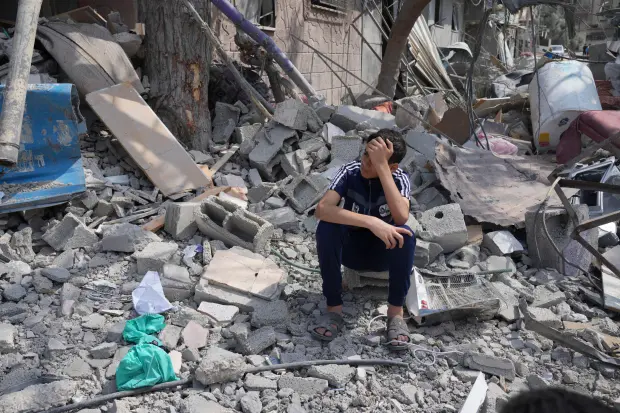
God – good and kind and wise; and King. And Gaza – blitzed and bombed, with buildings reduced to rubble and ruin, thousands left dead, and infants and children left wounded and maimed, distraught, disturbed, disoriented, and crying their eyes out in pain, perplexity, grief.
An all-together sovereign, gracious God. And the devastated, terrifying graveyard which the Gaza strip’s become. God and Gaza. How can the two co-exist? Where is God in Gaza?
It’s the question which churns in the minds and hearts of everyone sooner or later. If God’s in charge, why does He let it all happen? When disaster strikes – earthquakes, volcanoes, hurricanes, famine or floods: when conflicts erupt and buildings are bombed, communities wrecked, and thousands on thousands left homeless and helpless and harmed: when tyrants take power, oppressive and cruel and trampling on those in their way, with great rivers of blood flowing out in the wake of their rule: when those who are wealthy grow wealthier still and the poor, as a necessary consequence, end up sunk in a spiral of debt and impoverished into despair. Why doesn’t God put an end to it all? Why does He let it all happen? Why does He not sort it out?
Where is God in Gaza?
If He is the sovereign God – if He’s just, and good, and loving and strong, and running the cosmos as King – then why does He not step into the fray and sort the whole thing out? If God exists at all, that is, He seems conspicuous by His absence. Where is God in Gaza?
And it isn’t any different in our own small worlds; when everything suddenly falls apart; when a sudden bereavement tears your heart in two, and leaves your future a mess and in total tatters; when illness kicks in; when redundancy comes in later life and there’s little real hope of any fresh work; when your hopes are dashed; when your dreams turn into a nightmare; when all your best efforts seem to count in the end for nothing. Where is God in your Gaza?
Consider the case of a lady I know, now well up in years – a lady who had always struggled with the pain she’d known in younger years when her father died aged 54: her mother was left desolate – her future left in ruins, her children left bereft, bemused and fatherless. A Gaza-like experience for a young, impressionable girl – her whole world blown to bits. Where is God in Gaza for that girl?
She trusted in the dark, however, accepted that we cannot always know and understand the mystery of God’s ways, and gave her life to Christ. But the shadow of that former grief hung weighed heavy on her hurting heart – so much so that when in turn she met the man who’d prove to be her husband in due course, she pleaded with the Lord that she’d not have to bear the sort of sorrow that had left her mother desolate and widowed in that way. A devout and committed believer, entrusting her life to the Lord Jesus Christ, but nonetheless still pleading with the Lord: ‘Spare me, my Lord, such grief.’
And her husband? A fine and fruitful minister of God’s Word, a dear friend of mine, and wonderfully used by the Lord. Who died before his time. Aged 54. Twenty years and more on down the line, and still there’s a pain in the lady’s heart, and still there’s a part of her asking, ‘Where is God in Gaza?’ Still a part of her struggling to see why God should have let it happen, why God didn’t hear the cries of her heart and simply step in to spare her yet another searing, stabbing grief.
She trusts Him still. But it’s trusting in the dark. Trusting when she doesn’t have an answer to the questions which, years on, can still torment her broken heart. Where is God in that Gaza of grief?
To declare that He’s there in the thick of it all seems cheap and trite – and untrue. Because it certainly doesn’t look like He’s there: and if we persist in insisting that God is right there in the thick of things, then why is He simply doing nothing?
Unless, of course, we simply can’t see what He’s doing. Which is why it helps to celebrate afresh the birth of Jesus Christ year by year. Because it didn’t much look as if God was at work in the headline upheavals of Palestine way back then. The Romans ruled the land, a ruthless imperial and military machine which ground its subject peoples into towing Caesar’s line. A bureaucratic ruling which obliged the land’s inhabitants to take to the road, leave their homes and businesses, and trek off to a designated, distant destination. A frightened, angry ruler in Jerusalem, intent on causing mayhem, murder, massacre – call it what you will – in order to secure his own position in the land.
Not a million miles (in any sense) from what goes on in Gaza at this time. What we now term as ‘Christmas’ wasn’t pretty way back then. And where was God in that Gaza? Where was God in the iron-fisted might of Roman rule, in the widespread disruption that followed on Caesar’s decree, in the slaughter of the innocents in Bethlehem?
Well, you know the answer: right there, in the thick of it all! But it didn’t much look like God was there – and if He was, it didn’t much look to the natural eye as if He was doing anything. Where is God in Gaza? Because if He’s there, then why does He let it happen? Why does He allow such suffering, sorrow and sin?
And, of course, you might well have asked exactly the same if you’d stood at the foot of the cross on which, some thirty years on, an upright, godly carpenter from way up north was crucified. A cruel, callous means of execution at the best of times: but applied in this specific instance with a total disregard for any justice, and driven by a vitriol and venom on the part of those in power, Golgotha was this Gaza once again. And where is God in Gaza? It sure did not look much like the Lord was there, because if He was, and if He’s all that He’s cracked up to be (our angry man would have argued as he passed the upper room), then why did He not DO something?
What answer can we give our angry man?
Well, first, I suppose, we humbly acknowledge that we are, none of us, God: His ways are not our ways. We’re finite, mortal creatures, whose perspective is bound by our low-lying, limited viewpoint. God views things – and thus exercises all His righteous sovereignty – from the standpoint and perspective of eternity, with a wisdom that is far more comprehensive than our finite minds can ever have. That’s bound to make a difference, even if it leaves us often groping in the dark for answers that we’d wish to have.
We’re not, however, left wholly in the dark. The Scriptures give some pointers as to how we’re best to understand how God and Gaza strangely co-exist. Let me point you, then, to what, I suppose, are the two most prominent pointers the Scriptures afford: first, the gravity of sin, and then, as well, the mystery of grace.
We may well pay lip-service to the gravity of sin. The slips we make in what we say or do, for which we’re quick, perhaps to make apology: a bit of bad temper, a careless neglect, a thoughtless response. Poor choices, with their consequent, damaging fall-out. We get all that. We get, perhaps, that all such things are sin, an offence against the majesty and purity of God. And we may even get, moreover, that all such sin draws forth the righteous wrath and condemnation of this holy God.
But the world has by and large domesticated sin. And sometimes – surely Scripture teaches this – sometimes God withholds His kind, restraining hand to let us see the sheer, perverse enormity of sin, its huge, destructive power and its dark, relentless death-inflicting reign. Gaza is a showcase for the watching world, a startling revelation of what sin is really like. This is what happens when sin takes charge. Hamas engage in mass murder, with a loathing and a hatred for the people and nation of Israel. And Israel engages in angry revenge, with a cast-iron resolve to be rid of Hamas forever. God help any who get in the way of the cross-fire!
Sin takes no prisoners but deals only in the currency of death. It’s a frightening, terrible, hellish reality. We’re told that from the start. Adam and Eve in the garden of Eden may well have thought that sin was just a little thing – but it isn’t mere coincidence that the very next chapter sees brother murdering brother. Sin has invaded the planet, and its reign, we soon discover, is a terrible, horror-strewn thing.
There are times when, in mercy, God must awaken His world from its smug, self-satisfied complacency and open our eyes to the horrors of that hell from which He’s come in Christ to rescue us. God, in Gaza? Yes, indeed. God pulling back the curtain for a watching world to let us see the dark and dire enormity of sin, and urging us to ‘Take a look, and see what hell is like: is this what you want?’ Will we simply sleep-walk through this smell of hell? Or will it be a wake-up call which helps us see the plight of our humanity and the need we each one have of God’s salvation in His Son?
Is that what God is doing there in Gaza? Perhaps at least in part. But He’s also at work in ways that are mostly all hidden. Isn’t that always the case? The mystery of grace. “Faith means believing in advance what will only make sense in reverse,” as Philip Yancey once put it. It didn’t much look like the Lord was at work when the Caesar in Rome threw his weight all around and the king in Judea had innocent children all killed. It didn’t much look like the Lord was at work when the most righteous man to walk this earth was nailed to a cross and killed. But He was! Far from being inactive in these cruel and wicked days, God was at work, reconciling the world to Himself in Christ. Read to the end of the story! Or, put more simply – wait. God’s ways are not our ways, nor His timing ours.
Decades ago in my student days I injured my leg one night when out playing a game of football: when the tackle came in I thought at first I’d broken my leg, the pain was so severe. But it proved to be but a bruise and it soon disappeared. Or so I thought. Six weeks later, for no apparent reason, I started to feel a pain in my leg – just where the bruise had been. My leg started swelling, massively. The pain started throbbing, terribly. The swelling and pain only grew until I was crying out, quite literally, in agony. The doctor came, looked at the wound, asked for the whole back story – and ended up doing nothing!
“Nothing?” I cried, as I pleaded with him for some help. “You’re the doctor, you’re meant to do something!” I said. A where-is-God-in-Gaza sort of plea. He explained (from what I’d told him) that a cut I’d had on rusty, old barbed-wire some 3 years back or more, which then became infected and had left me for months with a catalogue of boils – my body, he said, had become, without me knowing it, a ‘poison-making factory’, and now this injury on the football field had triggered something like a personal Armageddon, where all the hordes of poison in my body were converging on the one same place: but they’ve not all arrived, the doctor declared. “And to deal with the problem in a way that is once and for all, I have to wait until the poison has all gathered there. Trust me,” he said, “you’ll have to be patient and wait. But I will get it sorted – and you will, in good time, be thankful for what I have done.”
God, in Gaza. Yes. It’s a matter of trust. As the psalmist puts it – “I remain confident of this: I will see the goodness of the Lord in the land of the living. Wait for the Lord; be strong and take heart and wait for the Lord.” His story ends well. Always. How and when and what will it be? We take that on trust.
With warm greetings in anticipation of our Christmas celebrations,
Your servant in Christ Jesus our Lord
Jeremy Middleton