Monthly Letter – December 2021

Saving Is What God Does

Dear Friends,

The Bible is a big book. But it’s not that complicated really.

Like the floodlights at a stadium, it simply shines a load of massive spotlights on the field of play to help us see what God is up to in His world. And what it is He’s up to can be summed up in a single word.

Salvation.

Jesus is the focus of the Bible. The centre of our Christmas celebrations. The one whose name encapsulates the essence of God’s message in His book.

His name tells you everything. Jesus – ‘the Lord saves’.

Verbs, far more than any fine superlatives – verbs describe the Lord. Perfect in His attributes, for sure. And potent in His wonderful activity. He acts. He works. He does things. And what He does is best summed up, and is most fully comprehended, in this single, simple verb embedded in His name.

The Lord saves. Jesus.

Stated with a thrilling, clear simplicity, that one small verb encompasses a multitude of different ways in which the living God reveals His bold creative genius and engages with humanity.

Saving is not simply what He does best: it’s simply what He does. That’s made clear from the get-go. Page one of the Lord’s self-disclosure. We tend to think of Genesis 1 and 2 as being all about the Creator: and then once we get into Genesis 3, the Lord has to change His clothes as it were and the Creator becomes the Saviour. As though these two – creation and salvation – were somehow two different things. When in truth they’re not. They’re just part and parcel of what God does.

What did ‘creation’ involve? It involved nothing less than the ‘saving’ work of the living God. Isn’t that the case? Bringing light into the darkness. Order into the chaos. And fulness into the emptiness and void. And what’s that, if not a picture of ‘salvation’? Darkness, chaos, and the dreadful void of our human experience all matched by the ‘saving’ activity of God. The story-line of the whole Bible is established in its opening two verses.

He’s the God who saves. And His salvation is simply a multi-faceted, kaleidoscopic extravaganza of divine activity. Always.

Remember the exodus from Egypt, that great Old Testament narrative which becomes in many ways the paradigm of all that God does? It’s the same, essential story.

“I have indeed seen the misery of my people in Egypt. I have heard them crying out because of their slave drivers, and I am concerned about their suffering. So I have come down to rescue them from the hand of the Egyptians and to bring them up out of that land into a good and spacious land, a land flowing with milk and honey” (Ex.3.7-8)

He sees the misery. Isn’t that what we read again and again in Genesis 1? “And God saw .. and God saw .. and God saw ..” Seeing – an integral part of His saving work.

He hears the groans. There’s a sense in which that’s again the echo of, an expression of what we read in Genesis 1 – the Spirit of God was hovering over the waters. As if the ‘groaning’ of a dark, chaotic void caused distinct reverberations in the ‘eardrums’ of the Lord.

And He feels the pain. The God who is wholly, only good: whose every word, whose every deed, whose every thought, whose every plan is only ever good: the God who ensures that everything’s always good: it pains Him when things are not as they ought to be, when things are not truly good. How can He not be concerned about their suffering? How can He not be concerned at the desperate, despair-laden darkness of their experience there in Egypt? How can He not be concerned about the empty, arduous drudgery of their endless, daily slavery? How can He not be concerned about the chaos which His people know when they’ve long since ceased to have the slightest say in how they live? Their world simply out of control.

So He comes. This, too, is part of the ‘saving’ activity of God. All there from the start of the story in Genesis 1. Into the darkness He comes. The darkness that was there at the start. The darkness of an Egypt over-ruled by a brute of a Pharaoh.

And He comes, you see, to rescue. To bring light into their darkness. Order into their chaos. Fulness into the void of their Egypt existence. To take them out of that land, out of that life-that-was-no-life. To bring them in to a land that is .. yes, good. Because He’s good.

But the ‘rescue’ is only a part of the ‘saving’ activity in which the Lord will engage. See all the verbs that are, all of them, packaged together in what gets called ‘salvation’. He sees. He hears. He feels. He comes. He takes them out. He brings them in.

The Lord saves. One verb to encompass them all. One Man to display them all. Jesus. The one who saves.

He sees. He’s always seeing: remember how He spotted Zacchaeus. He hears. He’s always hearing: remember how He heard the blind Bartimaeus’ cries. He feels. He’s always feeling, always full of compassion, groaning with that pit-of-the-stomach ache and pain as He feels the pain of the dark, chaotic, empty lives of helpless individuals who have gone astray like sheep without a shepherd. And so He comes. And when He came, anointed by the Spirit Himself, He only ever went around doing good, bringing healing, healing, healing. Out of the land of enslavement and pain, and into the realm of renewal.

Christmas marks His coming: but it’s only a part of the story. There’s the back-story also we need to know: He comes because He sees and hears and feels. And the sequel-story, too. He comes not just to reveal, not just to offer us some re-assuring words: but to rescue, restore, renew. Broken lives. Shattered hopes. A fallen world.

Salvation is no less than a re-creation. The two belong together, in the end they’re one and the same. Creation and salvation. That’s who God is and what He does.

The Lord saves. Described and defined by a verb. One verb which says it all.

Perhaps this year, as Christmas once again becomes a fleeting focal point across our nation’s life, a simple sort of punctuation mark amidst the busy, noisy chatter of society – perhaps this year, the message that a Saviour has been born to us, perhaps that striking message will strike home to us: and will indeed strike home with added forcefulness to those who’ve not before afforded it the ‘airtime’ it demands.

Do we not need some help in these days? Do we not need someone to rescue us all from the ‘waves and the breakers’ of crises which have cast a great shadow right over the globe? Do we not see the need for salvation?

Climate change. Covid. And culture: a culture which cancels: a culture that’s chosen to tear up the rule book, dispense with God’s guidelines, and finds itself now all at sea.

You’d have thought that such a trilogy of terror in our face would cause society at large at least to pause for one brief moment in its headlong rush to godlessness – and ask itself, ‘Perhaps it’s more a Saviour than ‘the science’ that we need.’

On all these three distinctive fronts, you’d have thought that the clear, compelling need there surely is for some sort of ‘rescue package’ – you’d have thought that that would prompt in people’s minds an openness to countenance again the angels’ thrilling message which has sounded out across the globe these past two long millennia. The Saviour, born for us today. Jesus. The Lord saves.

Covid-19 – the pandemic with all its restrictions, that is – Covid-19 has shown us how mortal, how frail and how vulnerable all of us are. The physical health of so many simply knocked out the ground for six. The mental health of the nation spinning dangerously into a freefall. The statistics of death paraded before all our eyes every night.

Is ‘the science’ (whoever decides what the science will actually say) – is ‘the science’ really the cure-all? Can ‘the science’ in truth be the ‘saviour’ we desperately need? Our malaise is surely much deeper than those depths which ‘the science’ purportedly plumbs. The dis-ease, and all the diseases by which we are plagued: the aches and the pains, the weariness, weakness and woes which we suffer in varying degrees: they’re all of them symptoms, not the sickness itself. For the ‘sickness’ from which we all suffer, the ‘virus’ which does all the damage, has its source in realms which ‘science’ itself cannot reach. It’s the virus of sin which lands us all, in the end of the day, not in a hospital bed, but in a coffin, a grave and a dreadful isolation and confinement for eternity. Darkness: the darkness of a chilly tomb. Chaos: the ‘disintegration’ of our crumbling frames. Void: the emptiness of a silent, lost eternity.

It’s not ‘the science’ we need, but a Saviour. A Saviour who sees our plight, hears our cries, feels our pain, comes to our aid and rescues us: taking us out of the tomb, healing us finally from every disease that there is, and bringing us in to that good and spacious land for which our deepest instinct always tells us we were made.

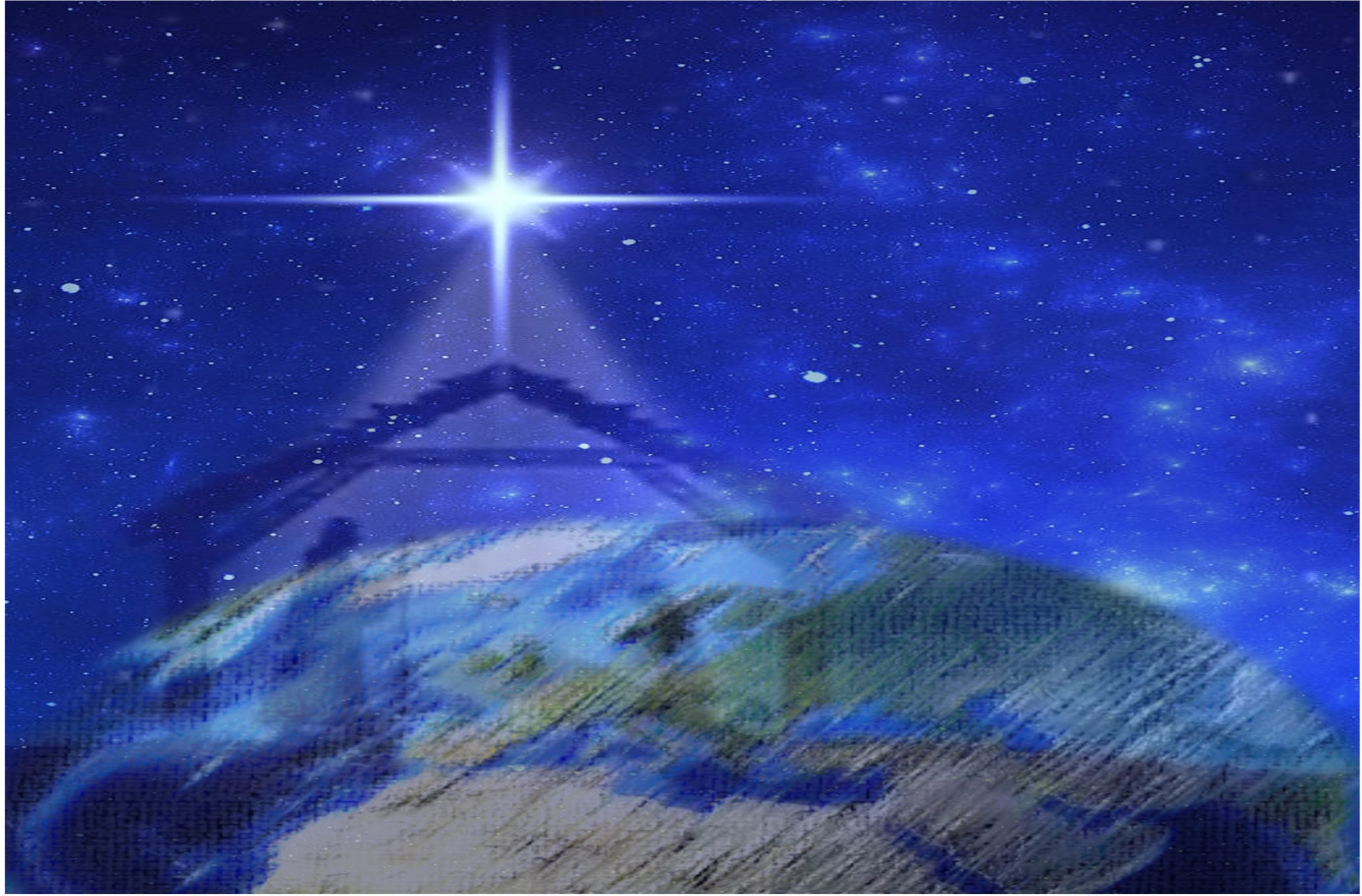
As the bright star in the heavens drew the wise men from the east to find the Saviour, might not the Covid pandemic in the providence of God be a different sort of flashing light exhorting folk to mount their metaphorical camels and travel to the one place where ‘salvation’ can be found? We pray so, surely.

Climate change issues are similar, too, are they not? For the salvation which God has effected in Christ encompasses all of the cosmos. It’s that great work of the Saviour Creator which alone gives meaning and hope in the midst of the present-day preoccupation with apocalyptic forecasts of impending global gloom. To try and understand the situation without due recognition of the two great Bible truths – the first to do with earth’s origins, the second to do with its final dissolution and renewal – to try and make sense of it all without those two great ‘bookends’ of God’s gracious revelation is a well-nigh impossible task: without such stabilising bookends, it must seem that the whole thing will likely fall apart. No wonder that people are fearful for what the future may rapidly bring.

And over against that comes the message of Christmas once more. “Do not be afraid,” declared the angel to the shepherds in the fields. A Saviour has come. And what need again – in the face of all these climate-change fears – what need again for the work of that wonderful Saviour, far more than merely the wit of contemporary science! For the work which this Saviour came to do is the great and thorough ‘un-doing’ of the damage which sin has so thoroughly done – damage which right from the start has affected the whole environment. That baby’s birth in Bethlehem led on to a cruel cross at Calvary: and that cross has its culmination in a final great renewal of the heavens and the earth.

Salvation is big! Big and bold and expansive in its scope. Just like the first great act of God recorded at the outset of His Word. The Creator has come in Jesus. Light instead of darkness. Order in place of the chaos. Fulness instead of the void.

Jesus saves.

The message is simple. What indeed could be more simply stated? But in its very simplicity, it speaks with astonishing pertinence into all of the major issues with which the world today is grappling. Let us not be afraid, then, though the earth give way and the mountains fall into the heart of the sea. Let us rejoice rather that the great Creator God Himself has come to us in Jesus. He, the LORD Almighty, is with us and what He has wrought for us in His Son secures us for eternity.

May you know His peace and rejoice in His grace through these coming weeks and all that they may bring.

Yours in the glad service of the Lord Jesus Christ,

Jeremy Middleton

Saving Is What God Does

Dear Friends,

The Bible is a big book. But it’s not that complicated really.

Like the floodlights at a stadium, it simply shines a load of massive spotlights on the field of play to help us see what God is up to in His world. And what it is He’s up to can be summed up in a single word.

Salvation.

Jesus is the focus of the Bible. The centre of our Christmas celebrations. The one whose name encapsulates the essence of God’s message in His book.

His name tells you everything. Jesus – ‘the Lord saves’.

Verbs, far more than any fine superlatives – verbs describe the Lord. Perfect in His attributes, for sure. And potent in His wonderful activity. He acts. He works. He does things. And what He does is best summed up, and is most fully comprehended, in this single, simple verb embedded in His name.

The Lord saves. Jesus.

Stated with a thrilling, clear simplicity, that one small verb encompasses a multitude of different ways in which the living God reveals His bold creative genius and engages with humanity.

Saving is not simply what He does best: it’s simply what He does. That’s made clear from the get-go. Page one of the Lord’s self-disclosure. We tend to think of Genesis 1 and 2 as being all about the Creator: and then once we get into Genesis 3, the Lord has to change His clothes as it were and the Creator becomes the Saviour. As though these two – creation and salvation – were somehow two different things. When in truth they’re not. They’re just part and parcel of what God does.

What did ‘creation’ involve? It involved nothing less than the ‘saving’ work of the living God. Isn’t that the case? Bringing light into the darkness. Order into the chaos. And fulness into the emptiness and void. And what’s that, if not a picture of ‘salvation’? Darkness, chaos, and the dreadful void of our human experience all matched by the ‘saving’ activity of God. The story-line of the whole Bible is established in its opening two verses.

He’s the God who saves. And His salvation is simply a multi-faceted, kaleidoscopic extravaganza of divine activity. Always.

Remember the exodus from Egypt, that great Old Testament narrative which becomes in many ways the paradigm of all that God does? It’s the same, essential story.

“I have indeed seen the misery of my people in Egypt. I have heard them crying out because of their slave drivers, and I am concerned about their suffering. So I have come down to rescue them from the hand of the Egyptians and to bring them up out of that land into a good and spacious land, a land flowing with milk and honey” (Ex.3.7-8)

He sees the misery. Isn’t that what we read again and again in Genesis 1? “And God saw .. and God saw .. and God saw ..” Seeing – an integral part of His saving work.

He hears the groans. There’s a sense in which that’s again the echo of, an expression of what we read in Genesis 1 – the Spirit of God was hovering over the waters. As if the ‘groaning’ of a dark, chaotic void caused distinct reverberations in the ‘eardrums’ of the Lord.

And He feels the pain. The God who is wholly, only good: whose every word, whose every deed, whose every thought, whose every plan is only ever good: the God who ensures that everything’s always good: it pains Him when things are not as they ought to be, when things are not truly good. How can He not be concerned about their suffering? How can He not be concerned at the desperate, despair-laden darkness of their experience there in Egypt? How can He not be concerned about the empty, arduous drudgery of their endless, daily slavery? How can He not be concerned about the chaos which His people know when they’ve long since ceased to have the slightest say in how they live? Their world simply out of control.

So He comes. This, too, is part of the ‘saving’ activity of God. All there from the start of the story in Genesis 1. Into the darkness He comes. The darkness that was there at the start. The darkness of an Egypt over-ruled by a brute of a Pharaoh.

And He comes, you see, to rescue. To bring light into their darkness. Order into their chaos. Fulness into the void of their Egypt existence. To take them out of that land, out of that life-that-was-no-life. To bring them in to a land that is .. yes, good. Because He’s good.

But the ‘rescue’ is only a part of the ‘saving’ activity in which the Lord will engage. See all the verbs that are, all of them, packaged together in what gets called ‘salvation’. He sees. He hears. He feels. He comes. He takes them out. He brings them in.

The Lord saves. One verb to encompass them all. One Man to display them all. Jesus. The one who saves.

He sees. He’s always seeing: remember how He spotted Zacchaeus. He hears. He’s always hearing: remember how He heard the blind Bartimaeus’ cries. He feels. He’s always feeling, always full of compassion, groaning with that pit-of-the-stomach ache and pain as He feels the pain of the dark, chaotic, empty lives of helpless individuals who have gone astray like sheep without a shepherd. And so He comes. And when He came, anointed by the Spirit Himself, He only ever went around doing good, bringing healing, healing, healing. Out of the land of enslavement and pain, and into the realm of renewal.

Christmas marks His coming: but it’s only a part of the story. There’s the back-story also we need to know: He comes because He sees and hears and feels. And the sequel-story, too. He comes not just to reveal, not just to offer us some re-assuring words: but to rescue, restore, renew. Broken lives. Shattered hopes. A fallen world.

Salvation is no less than a re-creation. The two belong together, in the end they’re one and the same. Creation and salvation. That’s who God is and what He does.

The Lord saves. Described and defined by a verb. One verb which says it all.

Perhaps this year, as Christmas once again becomes a fleeting focal point across our nation’s life, a simple sort of punctuation mark amidst the busy, noisy chatter of society – perhaps this year, the message that a Saviour has been born to us, perhaps that striking message will strike home to us: and will indeed strike home with added forcefulness to those who’ve not before afforded it the ‘airtime’ it demands.

Do we not need some help in these days? Do we not need someone to rescue us all from the ‘waves and the breakers’ of crises which have cast a great shadow right over the globe? Do we not see the need for salvation?

Climate change. Covid. And culture: a culture which cancels: a culture that’s chosen to tear up the rule book, dispense with God’s guidelines, and finds itself now all at sea.

You’d have thought that such a trilogy of terror in our face would cause society at large at least to pause for one brief moment in its headlong rush to godlessness – and ask itself, ‘Perhaps it’s more a Saviour than ‘the science’ that we need.’

On all these three distinctive fronts, you’d have thought that the clear, compelling need there surely is for some sort of ‘rescue package’ – you’d have thought that that would prompt in people’s minds an openness to countenance again the angels’ thrilling message which has sounded out across the globe these past two long millennia. The Saviour, born for us today. Jesus. The Lord saves.

Covid-19 – the pandemic with all its restrictions, that is – Covid-19 has shown us how mortal, how frail and how vulnerable all of us are. The physical health of so many simply knocked out the ground for six. The mental health of the nation spinning dangerously into a freefall. The statistics of death paraded before all our eyes every night.

Is ‘the science’ (whoever decides what the science will actually say) – is ‘the science’ really the cure-all? Can ‘the science’ in truth be the ‘saviour’ we desperately need? Our malaise is surely much deeper than those depths which ‘the science’ purportedly plumbs. The dis-ease, and all the diseases by which we are plagued: the aches and the pains, the weariness, weakness and woes which we suffer in varying degrees: they’re all of them symptoms, not the sickness itself. For the ‘sickness’ from which we all suffer, the ‘virus’ which does all the damage, has its source in realms which ‘science’ itself cannot reach. It’s the virus of sin which lands us all, in the end of the day, not in a hospital bed, but in a coffin, a grave and a dreadful isolation and confinement for eternity. Darkness: the darkness of a chilly tomb. Chaos: the ‘disintegration’ of our crumbling frames. Void: the emptiness of a silent, lost eternity.

It’s not ‘the science’ we need, but a Saviour. A Saviour who sees our plight, hears our cries, feels our pain, comes to our aid and rescues us: taking us out of the tomb, healing us finally from every disease that there is, and bringing us in to that good and spacious land for which our deepest instinct always tells us we were made.

As the bright star in the heavens drew the wise men from the east to find the Saviour, might not the Covid pandemic in the providence of God be a different sort of flashing light exhorting folk to mount their metaphorical camels and travel to the one place where ‘salvation’ can be found? We pray so, surely.

Climate change issues are similar, too, are they not? For the salvation which God has effected in Christ encompasses all of the cosmos. It’s that great work of the Saviour Creator which alone gives meaning and hope in the midst of the present-day preoccupation with apocalyptic forecasts of impending global gloom. To try and understand the situation without due recognition of the two great Bible truths – the first to do with earth’s origins, the second to do with its final dissolution and renewal – to try and make sense of it all without those two great ‘bookends’ of God’s gracious revelation is a well-nigh impossible task: without such stabilising bookends, it must seem that the whole thing will likely fall apart. No wonder that people are fearful for what the future may rapidly bring.

And over against that comes the message of Christmas once more. “Do not be afraid,” declared the angel to the shepherds in the fields. A Saviour has come. And what need again – in the face of all these climate-change fears – what need again for the work of that wonderful Saviour, far more than merely the wit of contemporary science! For the work which this Saviour came to do is the great and thorough ‘un-doing’ of the damage which sin has so thoroughly done – damage which right from the start has affected the whole environment. That baby’s birth in Bethlehem led on to a cruel cross at Calvary: and that cross has its culmination in a final great renewal of the heavens and the earth.

Salvation is big! Big and bold and expansive in its scope. Just like the first great act of God recorded at the outset of His Word. The Creator has come in Jesus. Light instead of darkness. Order in place of the chaos. Fulness instead of the void.

Jesus saves.

The message is simple. What indeed could be more simply stated? But in its very simplicity, it speaks with astonishing pertinence into all of the major issues with which the world today is grappling. Let us not be afraid, then, though the earth give way and the mountains fall into the heart of the sea. Let us rejoice rather that the great Creator God Himself has come to us in Jesus. He, the LORD Almighty, is with us and what He has wrought for us in His Son secures us for eternity.

May you know His peace and rejoice in His grace through these coming weeks and all that they may bring.

Yours in the glad service of the Lord Jesus Christ,

Jeremy Middleton